
Bottlenecks: Identifying, Impacting, and Optimizing Workflow

By Chris Reep
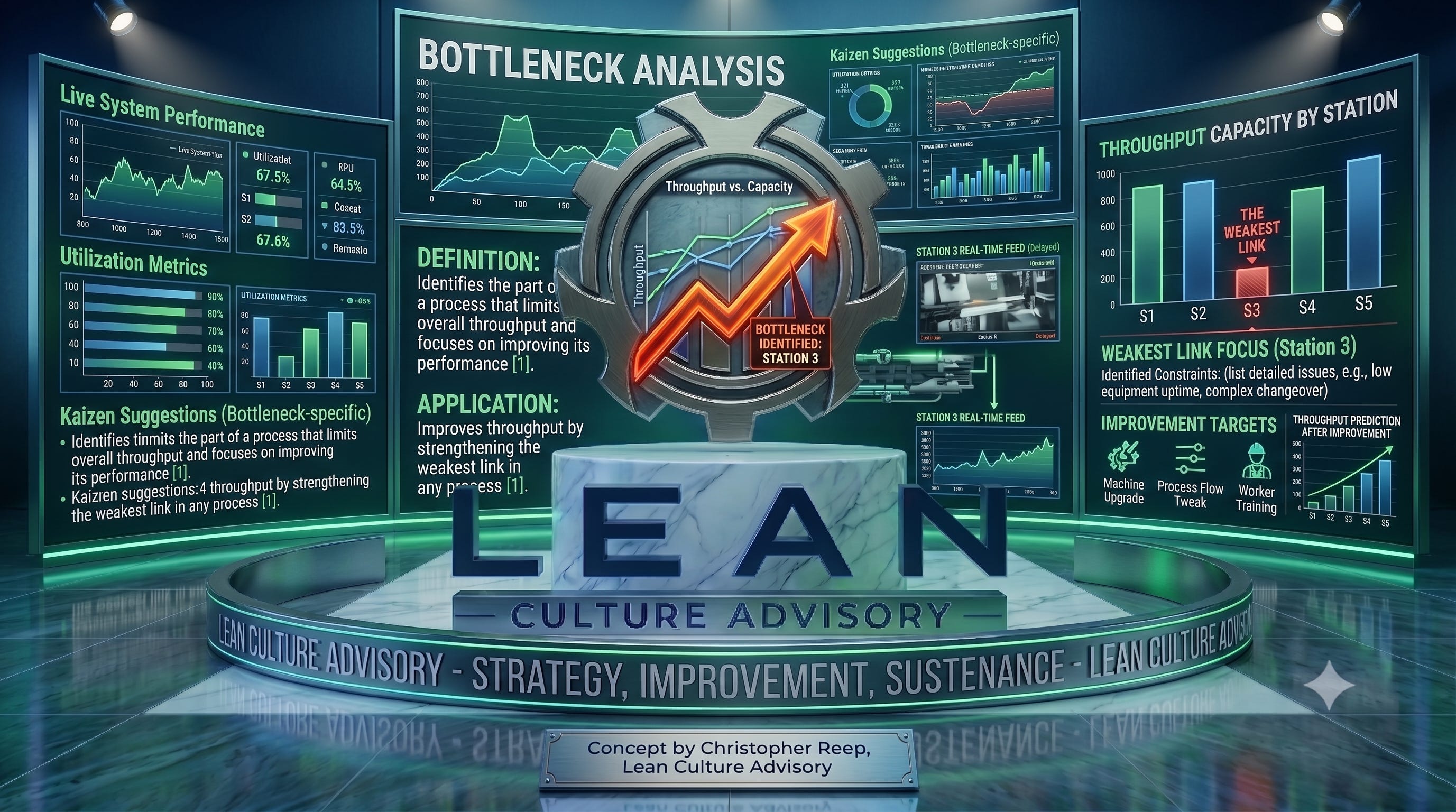
In any process, whether in manufacturing, service industries, or project management, the flow of work is critical to efficiency and productivity. However, this flow is often impeded by bottlenecks… points where work accumulates faster than it can be processed, slowing down the entire system. Understanding, identifying, and effectively managing these constraints is fundamental to Lean methodologies and crucial for optimizing operational performance.
What is a Bottleneck?
A bottleneck is a stage or step in a process that has a limited capacity, thereby restricting the overall throughput of the entire system. Much like a narrow neck of a bottle limits the flow of liquid, a bottleneck in a workflow limits the rate at which products or services can be delivered. These constraints can manifest in various forms, including overworked employees, outdated equipment, inefficient tools, or even external dependencies.
Impact of Bottlenecks
The presence of bottlenecks can have several detrimental effects on an organization:
• Reduced Throughput: The most direct impact is a decrease in the total output of the process, as the entire system is forced to operate at the pace of its slowest component.
• Increased Lead Times: Work-in-process (WIP) accumulates before the bottleneck, leading to longer waiting times and extended delivery schedules.
• Higher Costs: Excess inventory, wasted time, and potential rework due to rushed processes can significantly increase operational costs.
• Decreased Customer Satisfaction: Delays and inconsistent delivery can lead to unhappy customers and damage an organization’s reputation.
• Employee Frustration: Workers upstream of a bottleneck may experience idle time, while those at the bottleneck may feel overwhelmed, leading to decreased morale.
Identifying Bottlenecks
Accurately identifying bottlenecks is the first critical step toward resolving them. Several Lean tools and techniques can be employed for this purpose:
1. Value Stream Mapping (VSM)
Value Stream Mapping is a visual tool that illustrates the flow of materials and information from the beginning to the end of a process. By mapping out each step, including processing times, waiting times, and inventory levels, VSM clearly highlights areas where work accumulates, indicating potential bottlenecks.
2. Process Cycle Time Analysis
This technique involves breaking down a process into individual steps and measuring the time taken for each. Steps with disproportionately long cycle times or those that consistently exceed the takt time (the rate at which products must be produced to meet customer demand) are strong indicators of bottlenecks.
3. Gemba Walks and Direct Observation
Derived from the Japanese term for “the real place,” a Gemba Walk involves going to the actual work area to observe processes firsthand. Direct observation allows managers and Lean practitioners to witness the flow of work, identify queues, and gather insights from employees directly involved in the process, often revealing bottlenecks that data alone might miss.
4. Kanban Boards and Cycle Time Heatmaps
For processes managed with Kanban, visualizing all workflow stages can quickly reveal where work stalls. Kanban boards can be configured to show queues, and if these queues grow faster than they are processed, a bottleneck is present. Cycle Time Heatmaps provide a visual representation of the time tasks spend in each stage, pinpointing areas with the longest delays.
Root Cause Analysis for Bottlenecks
Once a bottleneck is identified, understanding its underlying cause is essential for effective resolution. Two common techniques for root cause analysis are:
1. The 5 Whys
The 5 Whys method involves repeatedly asking “why” a problem occurs until the fundamental root cause is uncovered. For example, if a packaging line is bottlenecked because a labeling machine is slow, asking “why” iteratively might reveal inadequate operator training as the root cause.
2. Fishbone (Ishikawa) Diagrams
Also known as cause-and-effect diagrams, Fishbone Diagrams visually categorize potential causes of a problem (e.g., people, machines, materials, methods, environment) to explore all contributing factors to a bottleneck. This structured approach helps teams brainstorm and identify comprehensive root causes.
Bottleneck Mitigation Strategies: The Theory of Constraints (TOC)
Eliyahu M. Goldratt’s Theory of Constraints (TOC) provides a powerful framework for managing bottlenecks. TOC posits that every system has at least one constraint, and focusing improvement efforts on this constraint is the most effective way to improve overall system performance. TOC outlines a five-step focusing process:
1 Identify the Constraint: Pinpoint the single part of the process that limits the rate at which the goal is achieved.
2 Exploit the Constraint: Maximize the output of the bottleneck using existing resources. This means ensuring the bottleneck is never idle and is always working on the most critical tasks.
3 Subordinate Everything Else: Align all other activities in the process to support the needs of the constraint. Non-bottleneck resources should operate at a pace dictated by the bottleneck.
4 Elevate the Constraint: If the constraint still exists after exploitation and subordination, consider further actions to increase its capacity. This might involve investing in new equipment, additional staffing, or process redesign.
5 Repeat the Process: Once a constraint is resolved, it will likely shift to another part of the system. The Five Focusing Steps are a continuous improvement cycle, emphasizing that improvement is an ongoing journey.
Other Mitigation Strategies
Beyond TOC, other Lean strategies contribute to bottleneck mitigation:
• Work-in-Process (WIP) Limits: Implementing WIP limits prevents upstream processes from overwhelming the bottleneck, ensuring a smoother flow.
• Batch Smartly: Grouping similar tasks can improve efficiency, but keeping batches small minimizes risk and allows for quicker adjustments.
• Process Improvements (Kaizen, Poka-Yoke): Continuous improvement initiatives (Kaizen) and mistake-proofing techniques (Poka-Yoke) can enhance the efficiency of bottleneck operations and prevent errors that lead to slowdowns.
• Resource Allocation: Strategically allocating resources, such as cross-training staff or providing additional equipment, can alleviate pressure on bottlenecks.
Conclusion
Bottlenecks are inherent in any complex system, but they are not insurmountable. By adopting a systematic approach to identification, root cause analysis, and strategic mitigation, organizations can transform these impediments into opportunities for significant improvement. The Lean concept of bottleneck analysis, particularly when integrated with the Theory of Constraints, empowers businesses to optimize their workflows, increase throughput, reduce costs, and ultimately deliver greater value to their customers. It is a continuous journey of identifying the weakest link and strengthening it, thereby fostering a culture of relentless pursuit of efficiency and excellence.